

The most popular advice for womens golf clothes petite is also the least useful: buy an extra-small and call it petite. That approach gives you a smaller circumference, not a better golf garment. You can still end up with a polo that reaches your hips, sleeves that cover your hands, an armhole that gaps, and a jacket that pulls across your back the moment you rotate through impact.
Petite golf fit is a proportion problem. Height, torso length, shoulder width, rise, inseam, sleeve length, and even hat crown depth determine whether your outfit moves cleanly or fights your swing. Once you stop treating petite as a synonym for tiny, shopping gets much more precise.
Why Petite Golf Apparel Is About Proportion Not Size
A petite golfer doesn't necessarily need the narrowest size on the rack. She needs clothing drafted for a shorter vertical frame, with the right relationship between circumference and length. A regular-size polo can fit across the bust and still fail because the shoulder seam sits too low, the armhole opens too wide, or the hem lands at an awkward point over the hips.
The distinction matters on the course. During a swing, excess torso fabric bunches at the lower back, long sleeves catch around the wrists, and a poorly placed hem shifts as you turn. Trousers bring their own problems. A regular rise can sit too high or too low, while a standard inseam may stack around the ankle and interfere with movement.
The practical rule: Choose the circumference that fits your body, then verify every important length separately.
The market is much broader than the industry's “petite equals extra-small” habit suggests. A Louisiana State University thesis citing U.S. Department of Commerce data reported that 47% of U.S. women ages 20 to 49 were 5 feet 4 inches or shorter, the conventional height threshold for petite clothing (Louisiana State University thesis). That doesn't mean all those women share the same shape. It means height and proportion deserve serious attention across a wide range of body types and sizes.
The same research identified recurring fit issues involving sleeve length, torso length, rise, inseam, and pocket placement. It also showed why petite apparel can't be defined only by small sizes. Sizes 14 and 16 had become regular sizes within the petite category, reinforcing the point that petite primarily describes height and proportion, not body weight.
What regular patterns get wrong
A regular pattern scaled down often preserves the wrong relationships. The garment may become narrower without shortening the back-waist length enough. Armholes can remain too deep, shoulders can stay too broad, and pockets can land below the natural hand position. Those flaws become obvious when you raise your arms, bend into address, or rotate through a full backswing.
Golf clothing has to do more than look tidy while standing still. A polo needs shoulder clearance without a collapsing neckline. A quarter-zip needs enough back length to stay covered at address, but not so much fabric that it balloons over the hips. A skort needs a stable rise, secure inner shorts, and a length that still looks intentional when you crouch to read a green.
For casual layering, a proportion-aware basic such as the FLYP LTD sunfade tee can help you judge whether a shorter body length sits where you want it. Treat that kind of piece as a reference for your preferred hem and sleeve proportions, not as proof that a smaller label solves every fit issue.
The better standard is simple: petite clothing should make your frame look balanced and let your swing stay uninterrupted. Don't buy the smallest label. Buy the pattern that respects your measurements.
The Dynamic Measurement Routine for Golfers
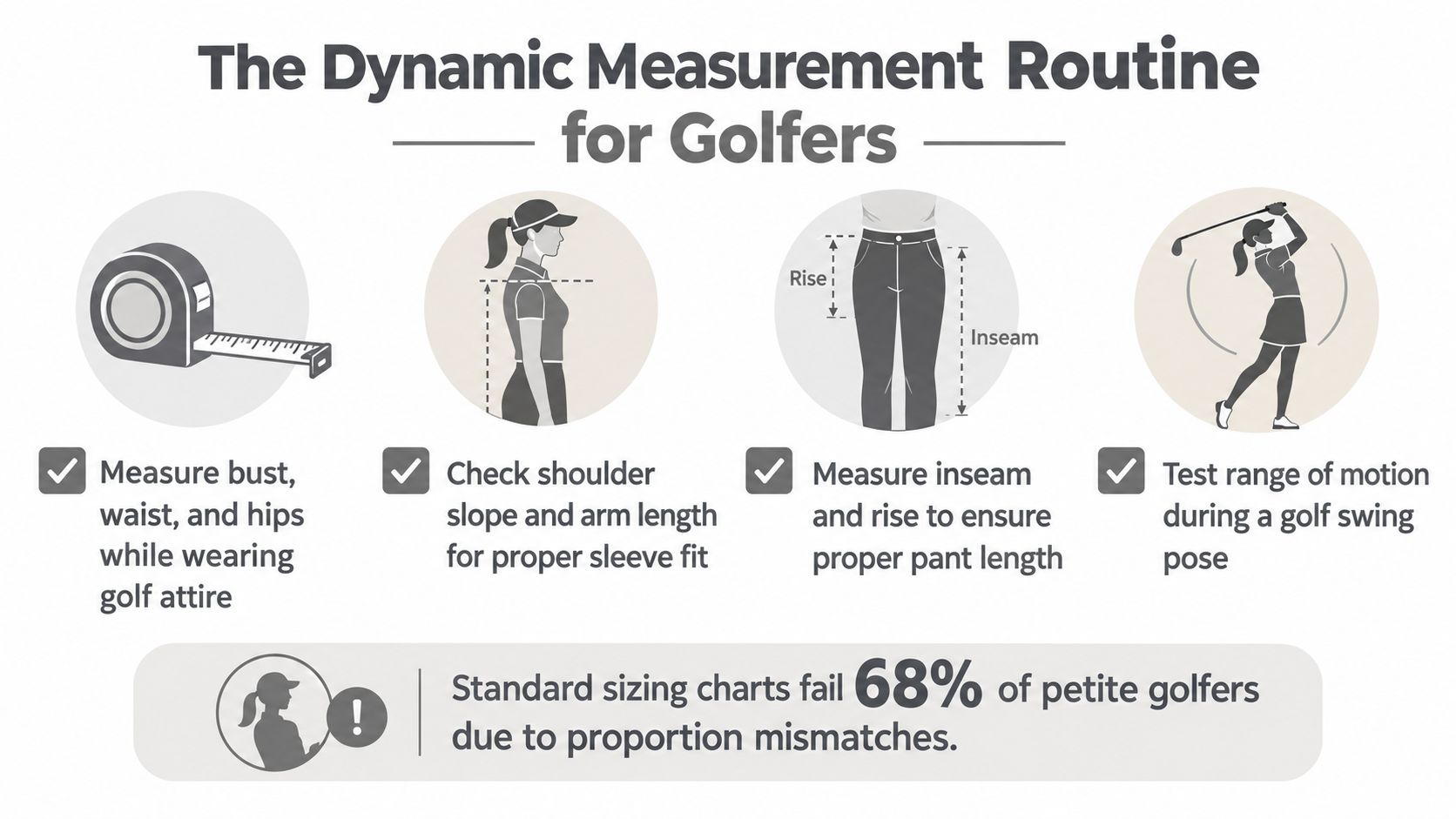
A static size chart can't tell you whether a shirt will stay put through impact. Build a personal fit profile instead, using a soft tape measure and the positions your clothes must handle on the course.
Start with the body measurements that affect movement
Wear a thin golf top and bottoms similar to what you normally play in. Keep the tape level, don't pull it tight, and record the numbers rather than relying on memory.
- Height and shoulder width: Measure height without shoes, then measure across the shoulders from shoulder point to shoulder point. Shoulder width helps you assess whether a polo or jacket is built for your frame, while height establishes whether the garment needs petite vertical proportions.
- Bust, waist, and hip: Measure the fullest part of the bust, the natural waist, and the fullest part of the hip. Compare each value with the brand's chart instead of choosing one size automatically across every garment category.
- Back-waist length: Measure from the prominent bone at the base of your neck down to your natural waist. This measurement is critical for polos, quarter-zips, dresses, and jackets. If the back-waist length is too long, fabric will gather at the lower back when you bend into address.
- Rise and inseam: Sit naturally and measure the rise from the front waist, through the crotch, to the back waist. Then measure the inseam from the crotch to the point where you want the hem to finish. Compare rise and inseam independently. A correct hip measurement doesn't guarantee a correct trouser fit.
- Sleeve and armhole needs: Measure from the shoulder point to the wrist with your arm slightly bent. Don't accept a sleeve that only works with your arm hanging straight. Golf sleeves need to accommodate a raised arm and a rotating shoulder.
A SizeUSA analysis of 2,981 women aged 18 to 35 found statistically meaningful petite-versus-regular differences across 42 body measurements, including average petite circumferences approximately 1.0 inch smaller at the bust and 0.8 inch smaller at the waist (SizeUSA analysis). The important takeaway isn't to subtract those values from your own body. It's that regular patterns don't become accurate just because a brand makes them narrower.
Test the garment in golf positions
Try every serious candidate in four positions:
- Neutral standing: Check shoulder seams, neckline stability, hem placement, and waistband position.
- Address: Bend from the hips as you would over the ball. The back hem should cover you without pulling sharply across the bust or upper back.
- Full backswing: Raise both arms and rotate your torso. The armhole shouldn't bind, and the sleeve shouldn't drag the shoulder seam downward.
- Follow-through: Finish the swing and check whether the garment twists, rides up, or exposes the waist.
This routine works for layers outside golf, too. A Cashmere Boutique style guide can help you think about sleeve and shirt proportions when comparing button-down layers for clubhouse wear.
For more detail on choosing the right top shape, use this guide to women's golf shirts. Bring your measurements with you, and treat the manufacturer's chart as a starting point, not a verdict.
Selecting Flattering Cuts for the Course
A flattering petite golf garment creates clean visual lines because it fits the body in motion. It doesn't rely on oversized stretch, excessive compression, or a shorter label. Look for controlled volume in the torso, a stable waistband, and pockets positioned where your hands naturally reach.
The quarter-zip is a good example. A straight, generous body can create a tent effect over the hips, especially when the hem is too long. A lightly tapered shape follows the torso without clinging and keeps the garment from shifting during rotation. Don't confuse tapered with tight. You need room across the bust and upper back, with less unnecessary fabric below the waist.
For polos, inspect the shoulder seam before the bust. If the seam sits beyond your shoulder point, the armhole will usually feel too loose and the sleeve will migrate when you swing. If the bust fits but the shoulder feels restrictive, size up only if the garment offers a shorter or petite length. Otherwise, you're solving one proportion problem by creating another.
Use the feature, not the label
A survey of 308 petite female students identified problematic garment length, waistline fit, overly loose armholes and sleeves, and inadequate ease at the hip, bust, and shoulder as primary fitting problems (petite fit survey). Those issues translate directly to golf. A garment that looks acceptable in a product photo can still shift during address or tug across the upper back at the top of the swing.
| Garment Type | Standard Fit Flaw | Petite-Friendly Feature |
|---|---|---|
| Polo | Long torso and low armhole | Shorter back-waist length, shaped shoulder, secure armhole |
| Quarter-zip | Excess fabric over the hips | Light taper with stretch across the upper back |
| Jacket | Sleeves cover the hands | Shorter sleeve with room for a raised arm |
| Skort | Rise shifts during bending | Stable mid or high rise with secure inner shorts |
| Trousers | Standard inseam stacks at the ankle | Petite inseam and a rise matched to your waist |
| Shorts | Pockets pull the garment downward | Shallow, reinforced pockets placed near the natural hip |
| Sun layer | Long body bunches at the lower back | Shorter hem with enough coverage at address |
Shop bottoms by four separate measurements
Don't judge a skort by the waist alone. Check the waist, hip, rise, and inseam separately. A waistband that fits while standing can dig in when you bend, while a generous hip cut may leave excess fabric at the side seams.
Pocket placement deserves attention, too. A deep pocket filled with tees, a glove, or a ball adds weight and can pull a petite trouser out of position. Look for pockets that sit flat, open easily, and don't drag the garment toward the floor.
A skort should pass the movement test before you consider color or pleating. Bend, rotate, take a long step, and simulate reaching into the pocket. If the inner shorts ride or the waistband rolls, the design isn't ready for your golf bag.
Scaling Headwear and Accessories to Your Frame
A petite outfit can be perfectly proportioned from the neck down and still look unbalanced because the hat is too deep or the brim extends too far across the face. Headwear isn't a minor finishing touch. It affects comfort, visibility, sun coverage, and the scale of the whole outfit.
Compare the main headwear shapes
Low-profile cap: Usually the safest starting point for a smaller frame. The crown sits closer to the head, and an adjustable closure lets you control security without forcing the hat too deep.
Deep-crown cap: Useful if you have thick hair or want more coverage, but it can swallow a petite face. Check whether the crown collapses neatly or stands tall and rigid.
Visor: Keeps the crown from overwhelming your head and works well with a ponytail. The tradeoff is less protection on top of the head, so you'll need to judge the weather and your preferred coverage.
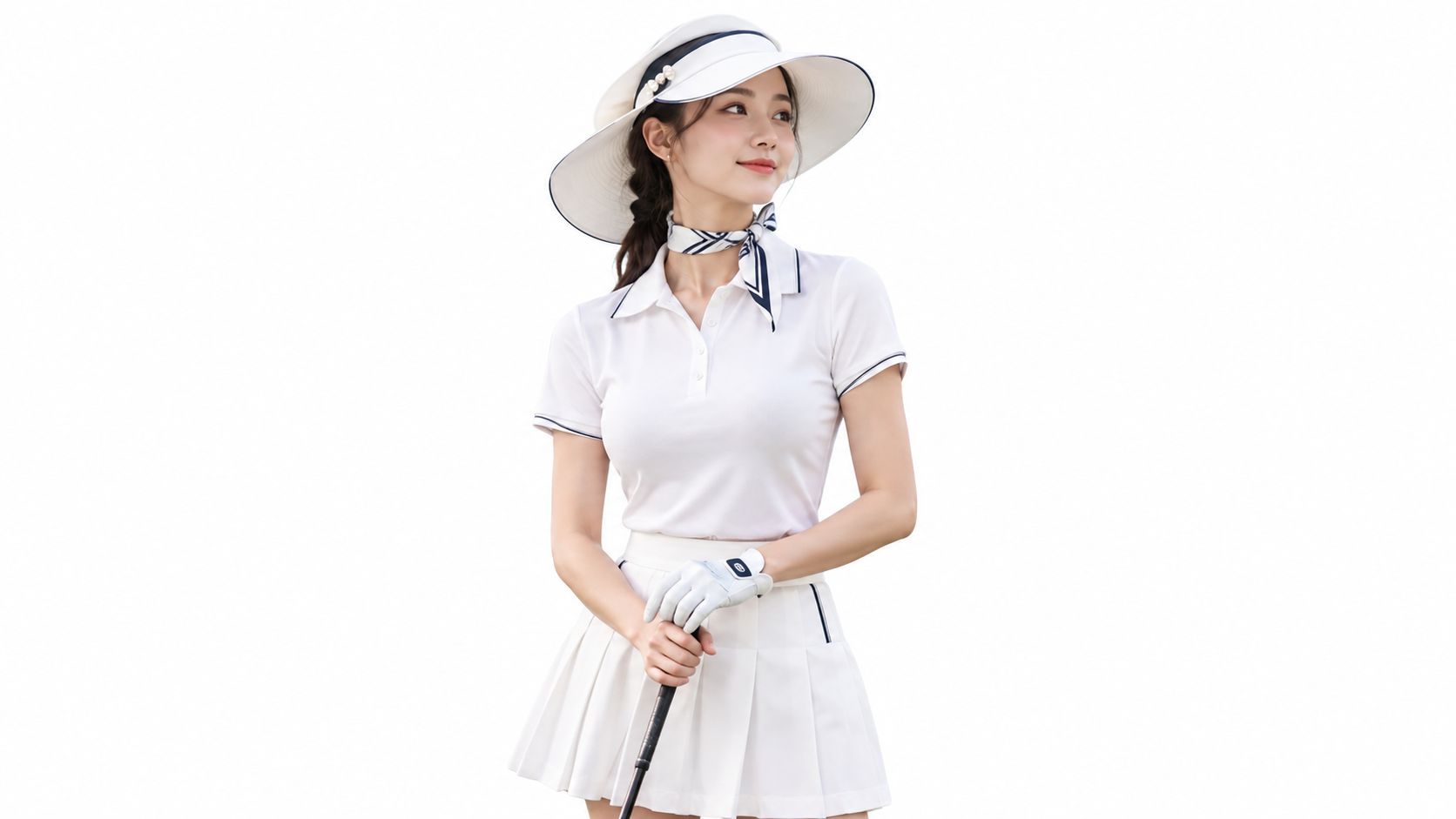
Wide-brim sun hat: Offers strong visual presence and can look elegant, but the brim should not obscure your peripheral vision during setup. A brim that repeatedly bumps your shoulders or shifts in the wind is a performance problem, not just a styling issue.
Beanie: Choose a close-fitting knit with controlled slouch. Excess fabric at the crown adds bulk and can make a petite head look smaller beneath the hat.
Market summaries emphasize women-specific tailoring and fashion, but often don't explain how crown height and brim length interact with smaller frames during a swing or in windy conditions (golf apparel market summary). That's the missing buying test. Don't ask only whether a hat is labeled women's. Ask whether its structure suits your head and remains stable while you move.
Fit check: Put the hat on, raise both arms, turn your head, and hold your finish. If you adjust it repeatedly, the closure, crown depth, or weight is wrong.
Hair volume changes the answer. A low ponytail can make a standard cap feel loose, while a bun needs a back opening and enough clearance. Try headwear with the hairstyle you usually wear on the course, not with your hair flattened for a fitting-room mirror.
For a reliable starting point, follow this guide on how to measure your head. Measure the head circumference, then inspect crown depth and adjustability as separate features. A correct circumference won't rescue a crown that's too tall.
Try this short visual reference for checking how headwear sits and moves:
Building Outfits for the Course and the 19th Hole
The best petite golf outfit doesn't require a complete change after the final putt. It uses the same proportion rules on the course and in the clubhouse, then adds one refined layer or accessory.
Start with a clean base: a polo or structured mock neck, a petite skort or fitted trouser, and a belt that doesn't overwhelm the waist. Keep the top hem intentional. A slight tuck can lengthen the leg line, while a full untucked hem works only if it finishes at a flattering point rather than covering the widest part of the hip.
Use formulas that control visual volume
Polished tournament look: Pair a fitted-but-mobile polo with a high-rise petite skort and a low-profile cap. Add a lightweight quarter-zip in a related neutral for the morning, then remove it at the clubhouse.
Executive casual: Choose a refined mock neck, petite ankle trousers, and a slim belt. Keep hardware discreet and let the trouser hem show a clean break rather than pooling over the shoe.
Sun-ready weekend outfit: Wear a shorter sun layer over a fitted polo, with a skort or fitted short below. The layer should cover the back at address but finish close enough to the body that it doesn't flap during a cart ride.
Clubhouse transition: Swap the cap for a compact brimmed hat or a polished beanie in cooler weather. If your golf top has a collar, leave it visible under the layer. That small bit of structure keeps the outfit connected to the course while making it feel intentional indoors.
A petite frame benefits from one focal point at a time. If the skort has pleats, keep the top quiet. If the polo has contrast piping, choose a clean bottom. Multiple oversized details create visual noise and make the wearer look surrounded by clothing.
Texture can add interest without adding bulk. Pair a smooth technical polo with a finely knit layer, or use a matte skort with a subtly structured jacket. Avoid stiff outerwear that forces the shoulders forward. Your layer should accommodate a raised arm and a rotated upper back without distorting the base outfit.
For course etiquette and practical outfit combinations, use this guide on how to dress for golf. Check the course's own dress code before a tournament or private-club visit, then build the outfit around fit rather than trend.
Tailoring Hacks and Final Fit Validations
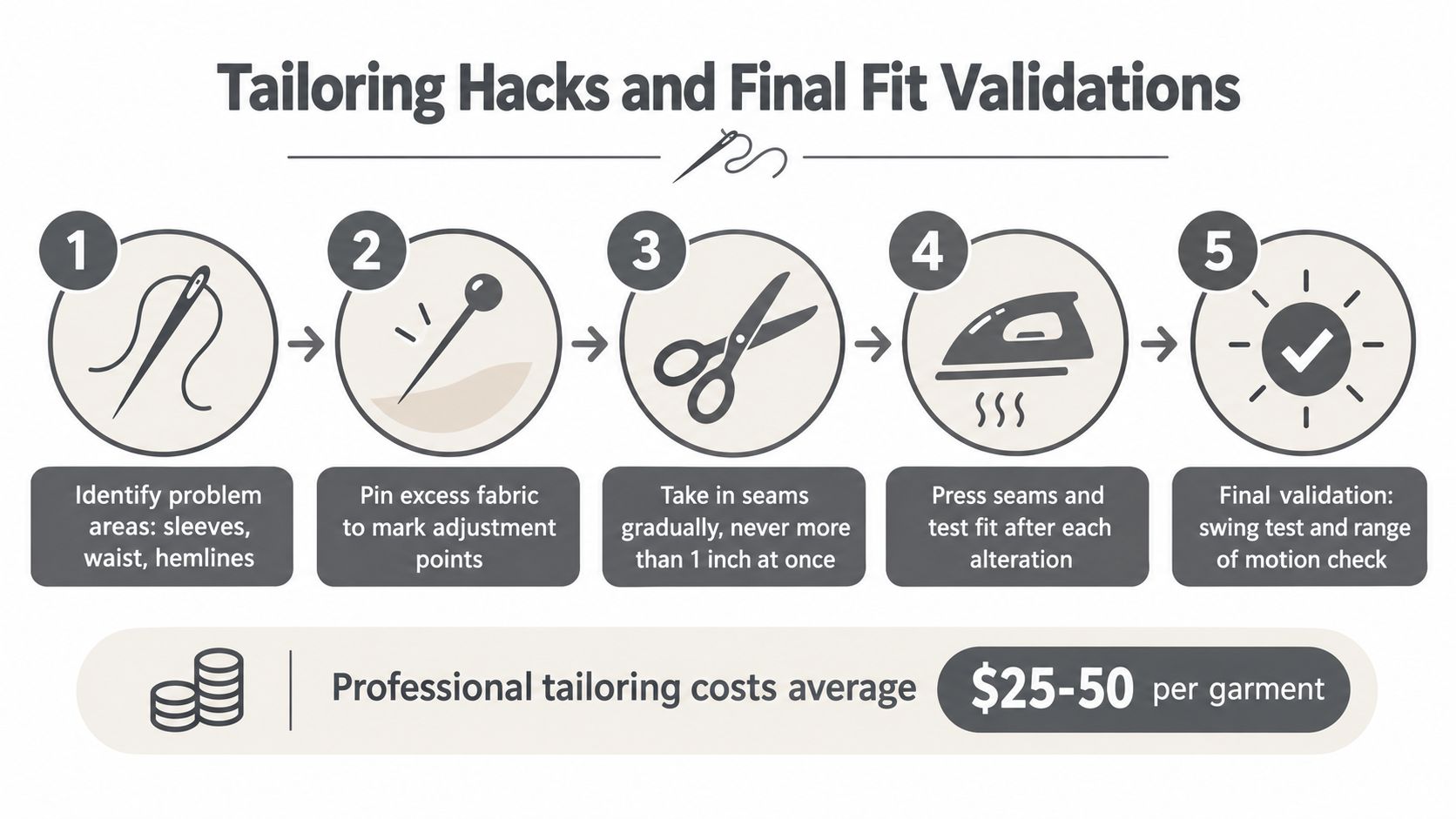
Petite-specific clothing improves your odds, but even a good garment may need a small adjustment. A tailor can usually rescue a near-perfect piece when the fabric, shoulder placement, and construction are already right.
Alter the easy wins first
- Hem trousers and skorts: Shortening the hem is often the cleanest fix, provided it doesn't remove a vent, pleat, or pocket.
- Adjust sleeve length: A sleeve can be shortened if the cuff or finish allows it. On performance garments, inspect the thumb opening, reflective trim, and elastic before approving the alteration.
- Take in side seams: A tailor can reduce excess width through the torso when the shoulders and bust already fit. Ask for gradual shaping rather than a severe taper.
- Refine the waistband: Waist gaping can sometimes be corrected at the center back or side seams. Don't sacrifice hip ease to make the waist smaller.
- Avoid shoulder surgery: Moving a shoulder seam or rebuilding an armhole is complex and can destroy the garment's balance. If the shoulder is wrong, return the item and start again.
For home maintenance and small pressing jobs, B-Sew Inn's expert advice on miniature irons is useful when you need precise control around hems, seams, and narrow finishes. Pressing isn't a substitute for fitting, but it helps altered seams settle cleanly.
Don't make aggressive changes to stretch technical fabric without testing it first. Mark the garment while wearing the base layers you'll use on the course, and keep the original seam allowance intact whenever possible.
Run the four-position validation
Perform the final test before removing tags:
- Neutral standing: Confirm that the neckline, shoulder seams, hem, waistband, and pockets sit flat.
- Address posture: Bend as you would over the ball. The hem should stay secure, and the back should not expose your waist.
- Full backswing: Raise and rotate both arms. The armhole should clear the shoulder, and the fabric shouldn't pull across the bust or upper back.
- Follow-through: Finish the rotation, then walk, sit, and reach. Check for twisting, riding, or waistband movement.
The benchmark is not a universal success percentage. The benchmark is zero restriction through the sequence and no visible horizontal drag lines in motion. If the garment fails, don't rationalize it because the color is perfect. Return it, tailor the appropriate seam, or choose a better pattern.
A swing-proof petite wardrobe starts with measurements, but it ends with movement. Shop for torso length, rise, sleeve placement, and headwear scale as deliberately as you shop for fabric and color. That's how you stop drowning in excess material and start looking as sharp at the 19th hole as you did on the first tee.
2ndShotMVP offers premium golf hats, beanies, and lifestyle apparel designed for confidence on and off the course. If you're rebuilding your petite golf wardrobe, explore 2ndShotMVP for headwear that can finish a balanced, swing-ready look.


![300 Yd Bombers Club - Fun MVP - WhiteFun Hat [FlexFit]300 Yd Bombers Club - Fun MVP - White](http://store.2ndshotmvp.com/cdn/shop/files/closed-back-structured-cap-white-front-67005555ae157.jpg?v=1747428788&width=480)
![300 Yd Bombers Club - Fun MVP - WhiteFun Hat [FlexFit]300 Yd Bombers Club - Fun MVP - White](http://store.2ndshotmvp.com/cdn/shop/files/closed-back-structured-cap-white-back-67005555b0682.jpg?v=1747428789&width=480)
![72 - Fun MVPFun Hat [FlexFit]72 - Fun MVP](http://store.2ndshotmvp.com/cdn/shop/files/closed-back-structured-cap-multicam-black-front-666a5fa015432.png?v=1747448488&width=480)
![72 - Fun MVPFun Hat [FlexFit]72 - Fun MVP](http://store.2ndshotmvp.com/cdn/shop/files/closed-back-structured-cap-multicam-black-back-666a5fa017c12.png?v=1747448489&width=480)