

The most popular advice about stylish women's golf clothes is wrong. A fitted polo, tiny skort, and delicate country-club finish might look excellent in a static photo, but that outfit has to survive a torso rotation, a humid back nine, a windy tee box, and lunch afterward. If the hem rides up during your swing or the neckline leaves your shoulders burning, the look has failed.
Style on a golf course is performance you can see. The right outfit stays in place, handles changing weather, respects the club's rules, and still looks intentional when you walk into the 19th hole. This guide judges golf clothing by real movement, practical coverage, body variation, climate, and course-to-casual versatility, not by how polished a model looks standing beside a golf cart.
Why Stylish No Longer Means Polished and Delicate
The old formula for women's golf fashion was easy to recognize: fitted polo, short skort, pale colors, tidy visor, and a silhouette that looked more prepared for a clubhouse portrait than a full round. That formula still has a place, but it's not the definition of style. A garment that pinches across your back or shifts every time you bend over the ball isn't elegant. It's distracting.
Women are entering golf through more routes than traditional club membership. Some are learning with friends, some are moving from the range to the course, some are fitting nine holes between work and dinner, and others want clothing that can move from the fairway to an everyday wardrobe. That variety demands more than a single polished silhouette.
My rule: If you wouldn't wear it for a practice swing, a long walk, and a clubhouse meal, it isn't a complete golf outfit.
The best stylish women's golf clothes now balance shape with ease. A top can have a clean shoulder line without squeezing the bust. A skort can look structured while giving you coverage when you squat to read a putt. A golf dress can feel feminine without relying on a fragile fabric or an impractical hem. Good design makes those decisions without fanfare, so you can concentrate on your swing instead of tugging at your clothes.
Judge the outfit by the round, not the photograph
Start with the situations your wardrobe needs to handle:
- Walking rounds: Look for stable hems, usable pockets, and fabrics that don't become clingy as you warm up.
- Range practice: Choose pieces with generous upper-back movement and bottoms that stay secure through repeated bending.
- Clubhouse transitions: Favor refined layers, clean lines, and accessories that don't look like an afterthought.
- Changing temperatures: Build around removable layers rather than one heavy garment that you'll carry after the first few holes.
This approach also makes shopping easier. Instead of asking whether a piece looks feminine enough, ask whether it supports the way you play. Instead of chasing a matching set, choose garments that work together across hot afternoons, cool mornings, casual nine-hole rounds, and post-round plans.
The modern golf wardrobe isn't less stylish because it moves. It's more stylish because it understands the body wearing it.
The Women's Golf Wave Behind the Fashion Boom
Women's golf fashion is growing because more women are playing, not because brands suddenly decided to make prettier polos. National Golf Foundation participation data reported by PGA Magazine says 6.4 million women played golf in the United States in 2024, up from 5.6 million five years earlier, a 15% increase. Men's participation rose only 2% in that stretch, and women accounted for roughly one in four traditional golfers. That is a real shift in who shows up at the tee box, the practice range, and the clubhouse afterward.
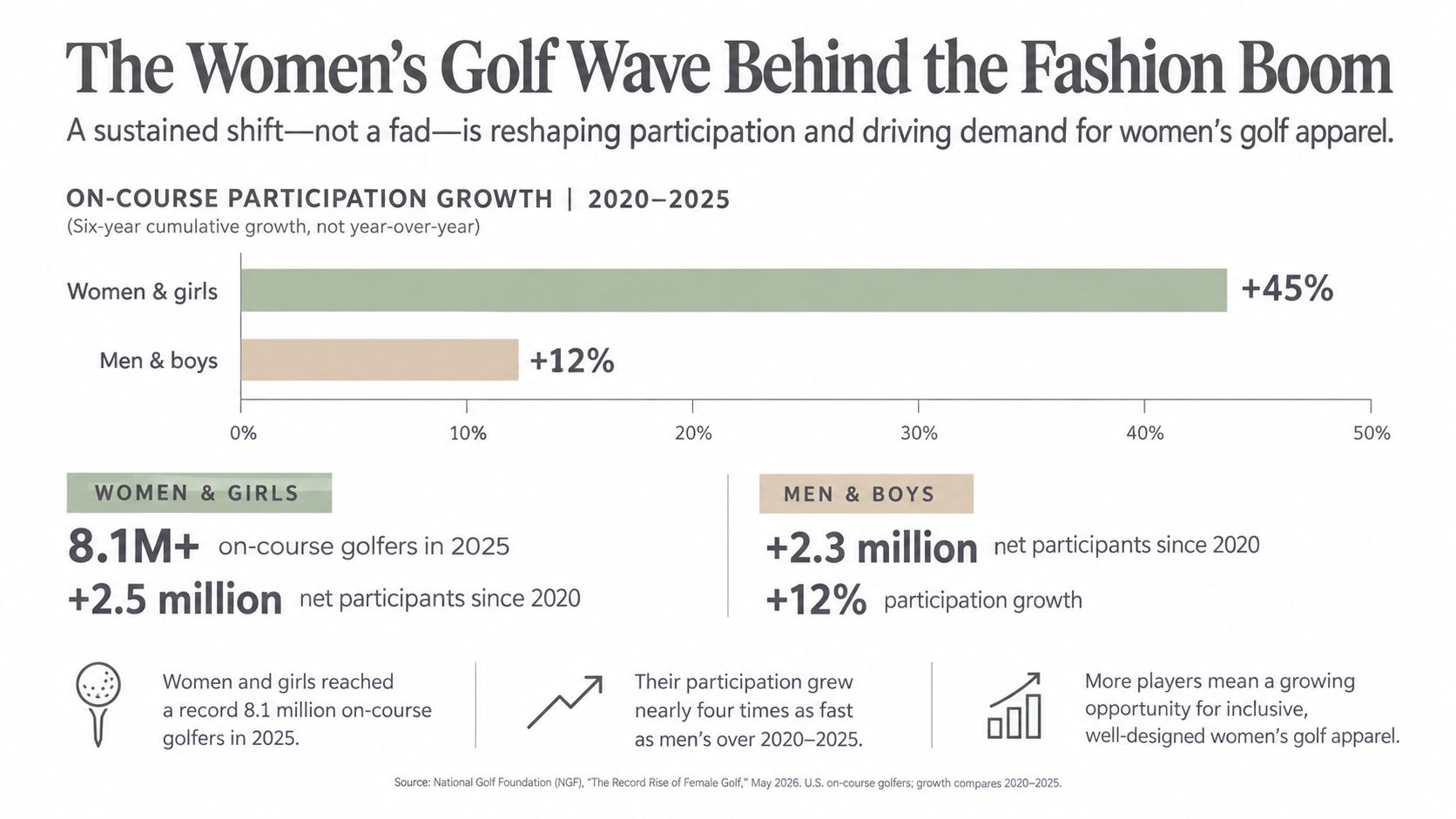
The junior side matters just as much. Women made up 38% of golfers under age 18, according to the same PGA Magazine report cited above. So the market is not built around one narrow type of player. It includes juniors, newer players, golf families, teachers, regular weekend walkers, and women who want clothes that still make sense once the round is over.
That broader audience changes what deserves your money. Brands now have a reason to cut tops and bottoms for movement first, then style them well. You see it in better proportions, stronger color choices, and fewer tired signals that women's golf wear has to look sweet, delicate, or overly coordinated. Good. Golf clothes should survive a full round, stay presentable at lunch, and still feel like your style.
That shift also has history behind it. PGA of America's account of women's golf fashion places the LPGA's 75th anniversary in 2025 inside a much longer move away from restrictive, formal clothing and toward mobility, performance, personal expression, and crossover wear. Modern women's golf style came from years of women claiming more space in the sport, not from a seasonal trend cycle.
It also explains why accessories and layers matter more than fashion guides usually admit. A golf hat is not just a finishing touch. It helps with coverage, softens the jump from course rules to personal style, and can make a newer player feel appropriately dressed without slipping into a stiff club look. The same goes for a polished quarter-zip, a knit layer, or a golf dress that works on the course and at the 19th hole.
The buying implication: Treat women's golf clothing as a real wardrobe category, not a one-off outfit for a trip or charity scramble.
Buy for the rounds you play. If you walk and sweat through humid afternoons, choose pieces that stay put and hold their shape. If your club is stricter, keep the base outfit clean and use color or accessories for personality. The category is bigger now. Your standards should be higher too.
How to Judge Fit Before You Ever Swing a Club
A dressing-room mirror only tells you how a garment looks while you stand still. Golf asks much more of it. Your shoulders rise, your torso rotates, your arms extend, and your body bends repeatedly through the round. Test those positions before you buy.
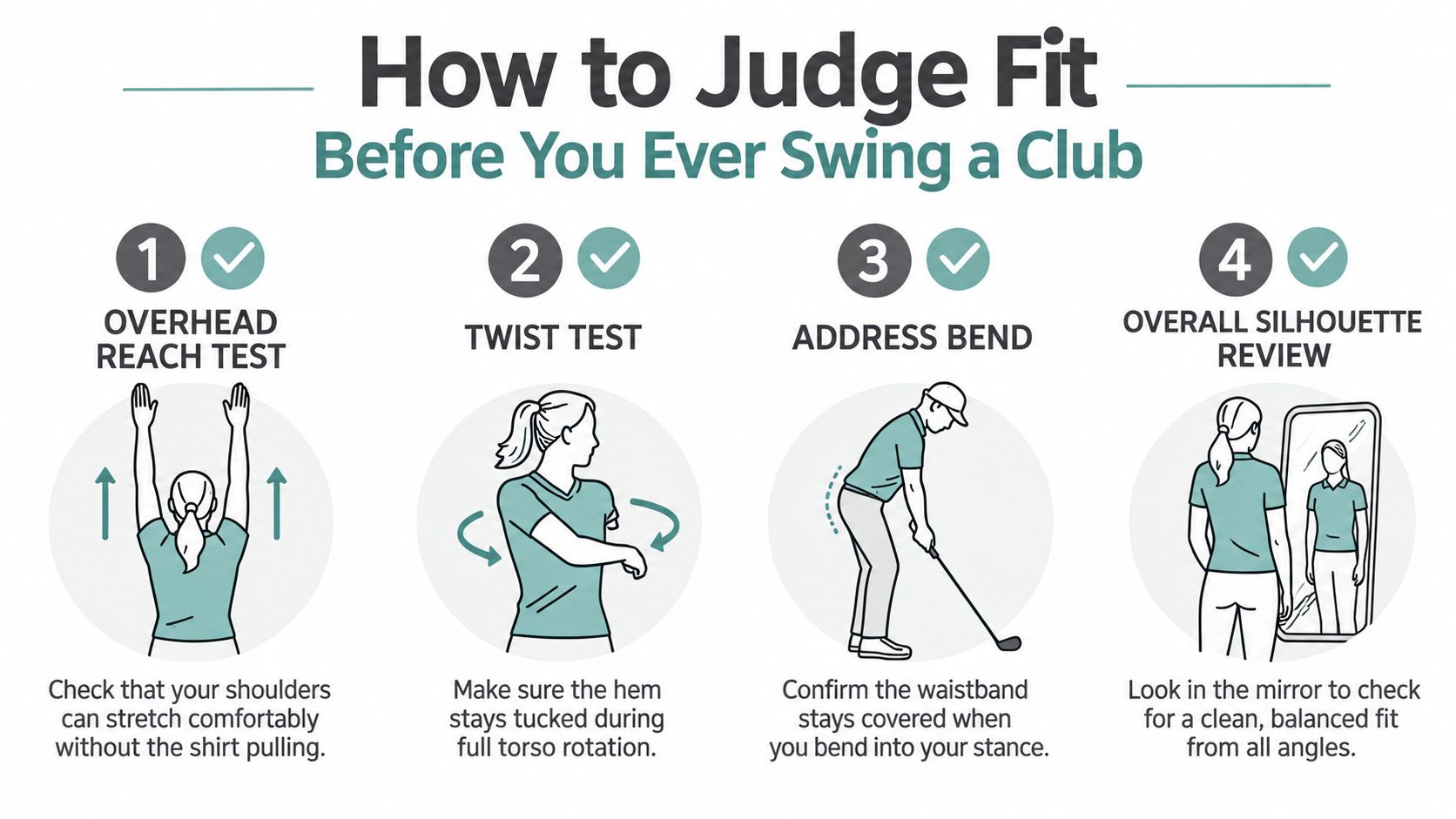
Run the four-part swing test
- Reach overhead. Raise both arms as if you're taking the club back. Check whether the shoulders pull, the armholes cut in, or the hem jumps toward your ribs. A good top gives your upper back room without turning boxy.
- Rotate your torso. Turn from side to side with your arms extended. Watch the hem. It should stay reasonably stable rather than twisting around your waist or exposing your midriff. Pay attention to the collar too, especially if the garment has a zipper or a high neckline.
- Bend at address. Hinge forward as though you're setting up over the ball. Check waistband coverage, back rise, and the position of the inner short in a skort. If you instinctively pull the garment down, it won't become more cooperative on the course.
- Review the silhouette in motion. Walk, squat, and make a slow follow-through. Look for seam pressure, bunching, gaping, and fabric that clings in the wrong places. The goal isn't a tight fit. It's a stable fit that keeps its shape while you move.
Research supports this more demanding approach. Motion-capture work on a female-athlete performance top found that a purpose-designed garment produced higher fit satisfaction and more optimal positioning during overhead movement than a control garment, although that result didn't automatically mean greater measured comfort or mobility. The Sports Engineering research points to a useful distinction: patterning controls how a garment behaves, while stretch alone doesn't prove that it will perform.
What to inspect beyond the size label
Look at the construction, not just the fiber content. Articulated sleeves can reduce pulling through the shoulders. Low-bulk seams can prevent pressure when you carry a bag. Strategic stretch panels can support rotation, while sufficient back ease helps the top stay stable through the takeaway and follow-through.
Body proportions vary, so static fit tests miss important problems. A bust-friendly top may need more length through the front. A player with broader shoulders may need extra back ease without sizing up through the waist. A shorter torso can make a long polo bunch under a vest. Try the garment in the positions you use instead of trusting a mannequin-like stance.
For bottoms, bend and step sideways. A skort's inner short should remain covered and comfortable when you reach for a ball. Shorts shouldn't cut into the thigh when you crouch. Trousers should flex at the hip without pulling at the front pockets.
A practical standard: The garment should disappear from your attention after the first tee. If you keep adjusting it, keep shopping.
Fabrics and Sun Protection That Actually Hold Up
A polished short-sleeve polo can cover your chest and back while leaving your shoulders, neck, arms, and hands exposed for hours. That isn't a small detail on a sunny course. Sun protection should be designed as a coordinated system, not reduced to a vague claim about lightweight fabric.
A 2025 evaluation of 671 golf-apparel items found that UPF labeling appeared on only 7.1% to 16.7% of garments. Chest and back coverage was nearly universal, but the arms, hands, and neck were frequently exposed, while field measurements identified the shoulder, back, and neck as important exposure areas.
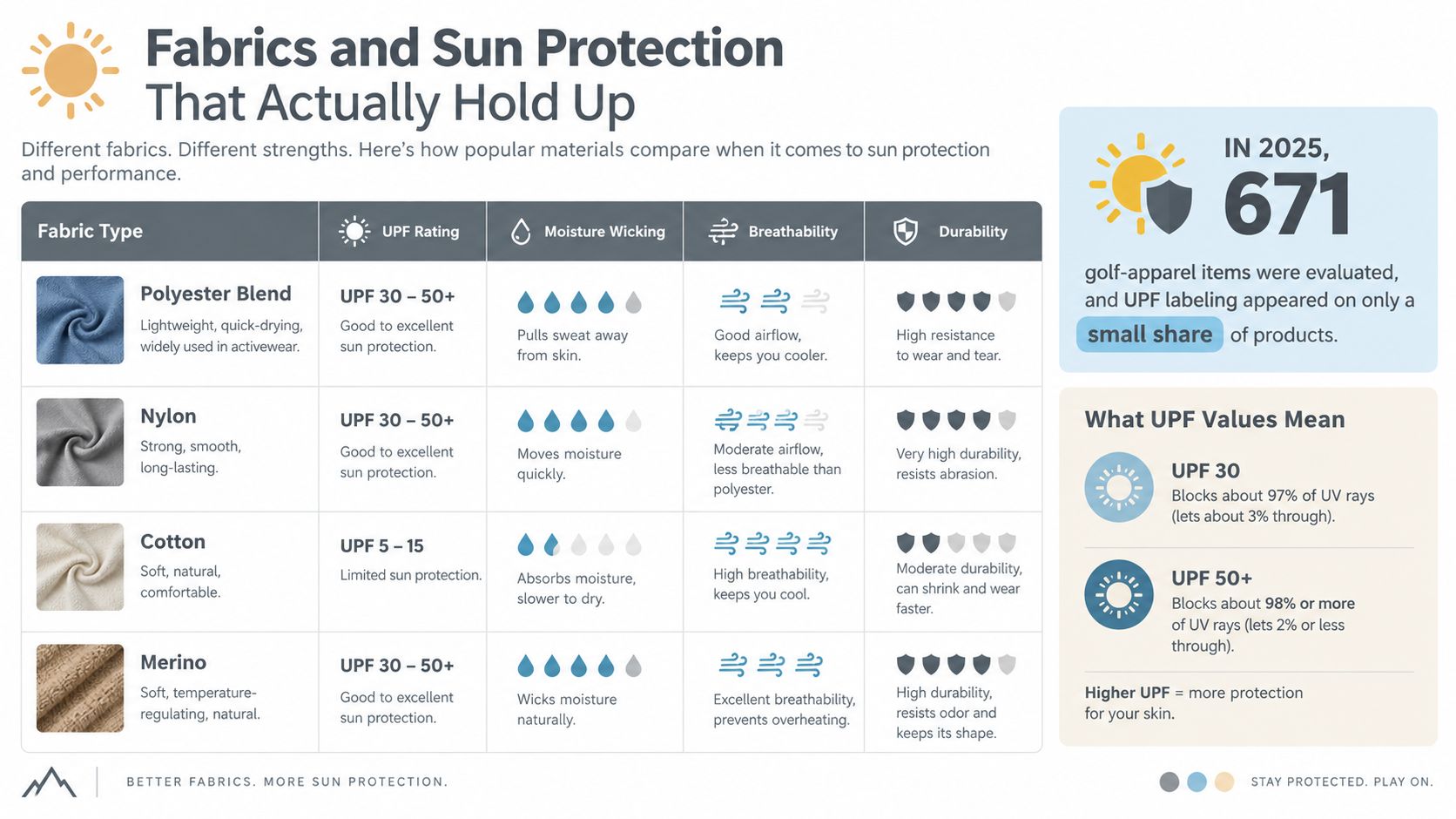
That finding changes the shopping question. Don't ask only whether a top feels cool. Ask whether it has verified UPF labeling, what parts of your body it covers, and how you'll protect the areas it leaves open.
Build coverage without ruining the look
For a premium golf wardrobe, prioritize:
- Longer sleeves or removable sleeves for rounds when shoulder exposure matters.
- Higher necklines that protect the back and sides of the neck without restricting rotation.
- Tightly woven fabrics rather than very loose constructions.
- Darker colors where practical, since darker fabric generally attenuates UV more effectively than pale fabric.
- Coordinated accessories such as a hat, neck-covering layer, or golf glove that protects the hands without interfering with your grip.
A lightweight long-sleeve top can look cleaner than a short-sleeve polo paired with several improvised accessories. A removable sleeve layer also gives you flexibility when the temperature changes. The point is not to cover every inch of skin at all times. It's to plan the exposed areas instead of discovering them halfway through the round.
For humid conditions, moisture management matters just as much as appearance. Learn how different constructions move sweat and dry between shots with this practical guide to what moisture-wicking fabric does. Choose fabrics that don't become transparent, clingy, or visibly saturated as the round progresses.
Cool mornings need a different strategy. Start with a breathable base, add a swing-friendly quarter-zip or vest, and remove the outer layer before it becomes a burden. Avoid bulky fashion sweaters that bunch across the back. Your outer layer should follow the movement of your arms, not fight it.
Sun-safe style is layered style. A certified UPF garment, a stable hat, and sensible neck and hand coverage will serve you better than a short-sleeve top with an unverified “sun-ready” label.
Outfit Ideas for Every Kind of Round
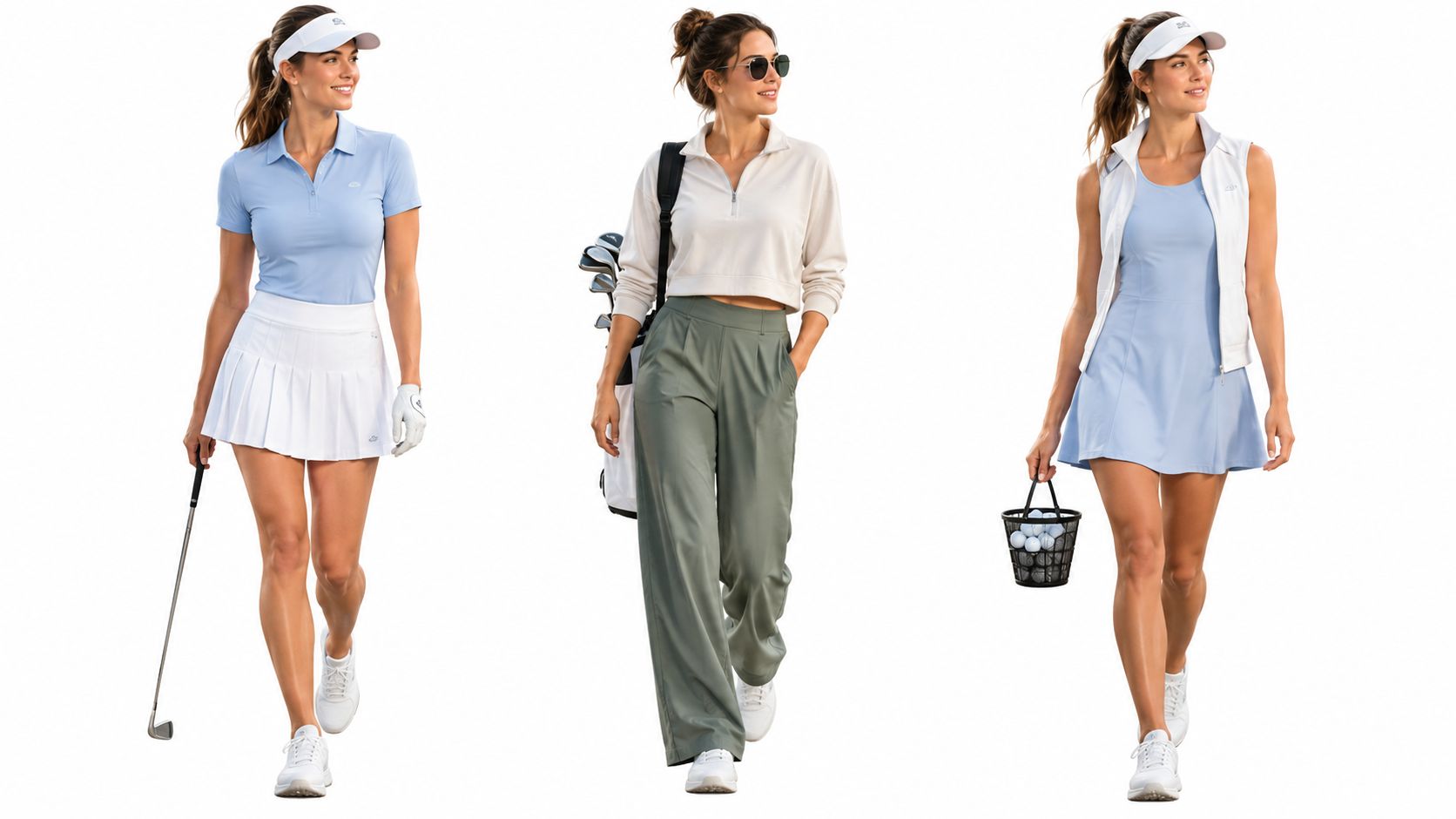
The strongest outfit formula depends on the round, not on a single definition of femininity. Walking 18 holes in humid heat calls for a different strategy from a quick range session or an office-to-course dash. The pieces below assume you've already checked movement and fabric performance. Now the fun part is combining them.
| Scenario | Key Pieces | Climate Layer | Style Note |
|---|---|---|---|
| Walking 18 | Stable skort or trousers, performance top, golf hat | Lightweight sun layer or removable sleeves | Keep the palette clean and let the hat provide the personality |
| Casual nine | Skort or tailored shorts, relaxed polo, spikeless shoes | Packable vest or light quarter-zip | Choose one playful color instead of making every piece compete |
| Range practice | Stretch top, secure bottoms, low-bulk layer | Breathable overshirt for changing temperatures | Prioritize unrestricted shoulders and a hem that stays put |
| Office to course | Refined polo or golf dress, tailored layer, compact accessories | Structured cardigan or polished jacket | Pick pieces that look deliberate before and after the round |
| Après-golf | Golf dress or neat trousers, statement hat, lightweight knit | Layer that works indoors | Use texture and accessories to make the outfit feel social, not uniform |
The walking-round formula
For a long summer round, I prefer a stable skort with a useful pocket layout, a top with shoulder coverage, and a hat that can handle sun and sweat without looking like an afterthought. Keep the color story simple, such as cream with navy, soft sage with sand, or charcoal with a warm neutral. A single statement accessory gives the outfit energy without adding visual clutter.
A casual nine is where you can loosen the formula. Try slim-cut shorts with a relaxed polo, or a golf dress with a lightweight layer tied or draped nearby. The look should feel easy, but not like you grabbed generic gym clothes on the way out.
For practice, work, and the 19th hole
Range practice rewards clothes that tolerate repetition. Choose a top with room across the upper back and bottoms that stay secure through constant bending. This is also the right setting for testing a new garment before committing it to a full round.
For an office-to-course transition, start with the layer that will make the outfit acceptable in both places. A refined quarter-zip, neat cardigan, or jacket can soften the athletic elements. A golf dress works particularly well when its collar, hem, and fabric look composed enough for lunch.
This guide to golf outfit ideas for women is useful when you want to build combinations around real occasions rather than buying isolated pieces. If you're choosing a golf-related gift for someone else, Golf Gift Vouchers can also help when fit, color, and personal style are difficult to predict.
A hat can pull together every one of these formulas. Choose a clean logo, an unusual color, or a playful phrase depending on the setting. A beanie can make a cool-weather outfit feel intentional, while a structured cap can carry a casual golf look into coffee, errands, or lunch. The right accessory doesn't rescue a poor outfit. It gives a functional outfit a point of view.
Decoding Dress Codes Without Losing Your Style
“Golf appropriate” isn't a universal category. A municipal course may be relaxed, a private club may expect a collared top and conservative bottoms, a resort may interpret neatness differently, and a simulator may have almost no traditional clothing expectations. Treat the local policy as a practical detail to verify, not as a reason to erase your style.
Research on engaging women in golf reports recurring concerns around poor fit, limited femininity, excessive reliance on pink and purple, sexism, and discouraging dress codes. The same research notes that women represented 35% of golf beginners in 2025, making clear guidance especially important for players who haven't yet learned each course's unwritten rules. Read the guide to how to dress for the course before a new venue if you want a useful starting point.
Use a ten-minute pre-round checklist
- Check the current policy: Look on the club's website, booking page, or member information. Rules can vary by course and may change.
- Ask about specific garments: Confirm whether sleeveless tops, leggings, shorts, and hats are permitted instead of guessing from vague wording.
- Clarify clubhouse headwear rules: A hat that's fine outdoors may need to come off inside.
- Pack a compliant backup: A lightweight collared layer or neutral pullover can save an outfit if the first choice doesn't meet the local standard.
- Plan the full route: Consider the parking area, practice range, course, clubhouse, and restaurant, not just the first tee.
The safest way to keep personality is to make your foundation compliant and put expression into details. A navy or cream polo can support a bright hat. A conservative skort can work with a patterned layer. A simple golf dress can gain character from a textured cardigan, distinctive earrings, or a carefully chosen cap.
Style strategy: Let the dress code determine the boundaries, not your entire identity.
Avoid waiting until the night before a tournament or private-club visit. Try the complete outfit while bending, rotating, and adding the backup layer. Your goal is confidence, not anxiety. Once you know the rules, you can make deliberate choices instead of dressing defensively.
For a broader explanation of proper golf attire, focus on the difference between written rules and local expectations. A course may technically allow an item but still expect a more traditional clubhouse appearance. When in doubt, ask directly and choose the version that lets you play without a confrontation at check-in.
Building a Wardrobe That Works From First Tee to 19th Hole
Build your wardrobe as a system, not a matching set. Start with one top that passes the swing test, one bottom that behaves when you bend, one verified sun-protective layer, and one accessory that gives the outfit personality. Add a transitional layer for your most common weather instead of buying another top that solves no real problem.
The course-to-19th-hole framework is simple:
- Performance foundation: A stable top and bottom that move with your swing.
- Coverage layer: Verified UPF protection or a practical sun system for shoulders, neck, and arms.
- Weather layer: A vest, quarter-zip, or jacket that doesn't restrict the upper back.
- Personal finish: A golf hat, beanie, or lifestyle accessory that works beyond the course.
- Rule-ready backup: One compliant layer for unfamiliar clubs and events.
Women represented 28% of U.S. on-course golfers in 2025, with more than 8 million participants, and participation was 46% higher than in 2019, according to the National Golf Foundation's golf industry research. More than half of recent female participation gains came from women under 30, so the future of golf fashion belongs to clothing that works across ages, body types, playing levels, and social settings.
If you want to compare broader golf clothing options, Vice Golf's apparel lineup offers another reference point for building a casual, expressive wardrobe. The important test remains the same: does each piece earn its place through movement, comfort, coverage, and repeat wear?
Stylish golf clothes shouldn't look fragile. They should survive the swing, the sun, the walk, and the lunch that follows.
2ndShotMVP offers premium golf hats, beanies, and lifestyle apparel for women and men, including expressive headwear that works on the course and beyond it. Visit 2ndShotMVP to find the finishing piece that gives your next golf outfit personality without sacrificing everyday wearability.


![300 Yd Bombers Club - Fun MVP - WhiteFun Hat [FlexFit]300 Yd Bombers Club - Fun MVP - White](http://store.2ndshotmvp.com/cdn/shop/files/closed-back-structured-cap-white-front-67005555ae157.jpg?v=1747428788&width=480)
![300 Yd Bombers Club - Fun MVP - WhiteFun Hat [FlexFit]300 Yd Bombers Club - Fun MVP - White](http://store.2ndshotmvp.com/cdn/shop/files/closed-back-structured-cap-white-back-67005555b0682.jpg?v=1747428789&width=480)
![72 - Fun MVPFun Hat [FlexFit]72 - Fun MVP](http://store.2ndshotmvp.com/cdn/shop/files/closed-back-structured-cap-multicam-black-front-666a5fa015432.png?v=1747448488&width=480)
![72 - Fun MVPFun Hat [FlexFit]72 - Fun MVP](http://store.2ndshotmvp.com/cdn/shop/files/closed-back-structured-cap-multicam-black-back-666a5fa017c12.png?v=1747448489&width=480)