

Noon tee time. Cart path shimmering. You've got sunglasses on, a decent polo, and the same baseball cap you wear for everything from range sessions to dog walks. Then you get home, look in the mirror, and your ears are red, the side of your face feels cooked, and the back of your neck looks like it spent the day on a beach without adult supervision.
That's the trap with men's sun hats. Most guys think “hat” and “sun protection” are basically the same thing. They aren't. A cap can help with glare and still do a lousy job protecting the parts of your face and neck that get hammered outdoors.
The question isn't “What's the best sun hat?” It's “What hat will I wear, in real heat and wind, covering the zones I keep missing?” For golf, walking the dog, driving, yard work, and travel, the answer usually comes down to coverage geometry first, fabric second, comfort third. Get that order wrong and you end up with a great label and a bad tan line.
Why Your Current Hat Probably Is Not Protecting You
A lot of men already own a hat they think counts. Usually it's a cap. It looks sharp, works with sunglasses, and doesn't make you feel like you're headed on safari when you're really just trying to play 18 and grab a burger after.
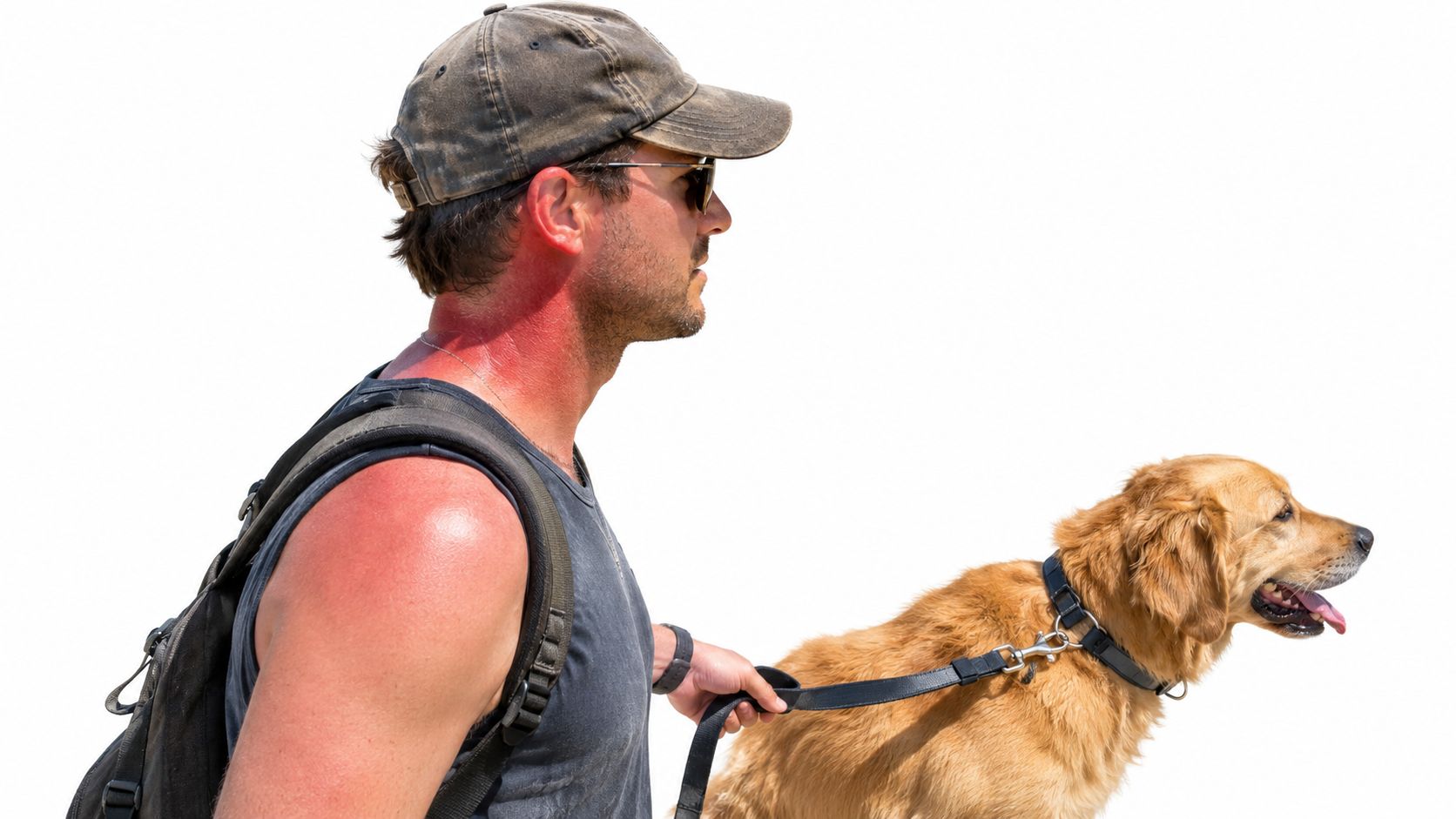
The problem is simple. A cap shades what's directly under the bill. That helps your eyes and forehead. It does much less for your ears, side face, lower cheeks, and neck. Independent headform research found small-brim caps provide negligible protection beyond the forehead, and wide brims greater than 7.5 cm are needed to achieve reasonable protection factors above 3 around the nose and cheeks in many positions of exposure (PubMed headform study).
That lines up with what guys wear. In a study of men in the west of Ireland, 68% reported wearing a hat on a sunny day, but 54% chose baseball caps while only 20% wore wide-brimmed hats (British Journal of Dermatology abstract). Style wins a lot of these decisions before protection even enters the room.
Why men keep choosing caps
Some of this is vanity. Some of it is practical.
- Caps feel normal: You can wear one on the course, at the hardware store, or on a coffee run without thinking about it.
- Wide brims can annoy golfers: They catch wind, brush hoodie collars, and sometimes interfere with a backswing if the brim is floppy enough.
- A lot of broad hats look better online than on your head: Men know this instinctively, so they retreat to the safe pick.
Broad-brim hats and bucket hats typically provide better facial protection than caps, but men still need a version they won't leave in the trunk.
The smarter way to think about hats
If you're shopping for hats for sun protection for men, stop asking whether the hat is “sun rated” and start asking what it covers when you're moving.
Use this mental checklist:
| Zone | Cap | Bucket | Broad brim |
|---|---|---|---|
| Forehead | Good | Good | Good |
| Ears | Weak | Better | Strong |
| Cheeks | Weak | Better | Strong |
| Neck | Weak | Moderate | Better |
No hat does everything. The same headform study noted that no hat style reached 100% protection, which is why hats should be paired with sunscreen and sunglasses for exposed areas (PubMed headform study). If your ears, jawline, or neck are still seeing daylight, they still need help.
Understanding UPF Ratings and What They Really Mean
UPF is the spec men notice because it's printed on tags, product pages, and hang cards. That's useful, but only if you understand what it measures.
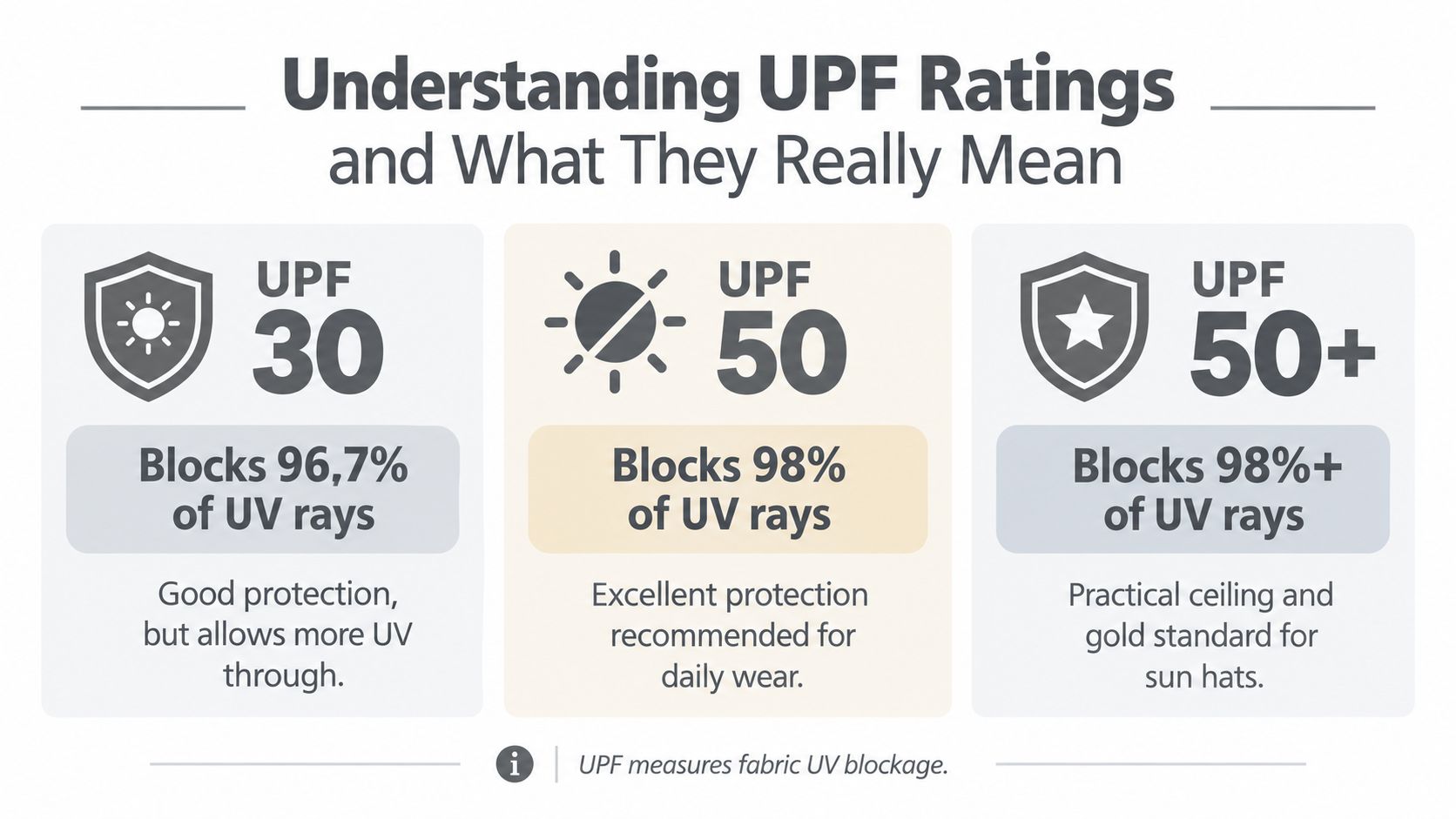
UPF stands for Ultraviolet Protection Factor. For fabric, UPF 50 means only 1/50 of UV radiation passes through, so it blocks about 98% of UVA and UVB rays. Current expert and industry references also describe UPF 50+ as the highest practical fabric-based protection level for hats, and ratings in the UPF 30 to 50+ range are commonly recommended for reliable sun safety (NBC Select explainer on UPF hats).
What UPF does tell you
UPF is about the fabric. It answers a narrow question: how much UV gets through the material itself?
That matters. If you're comparing a flimsy fashion hat to a purpose-built outdoor hat, the better fabric is a real upgrade. If you want a broader skin-first perspective on hats, face coverings, and exposed zones, this clinical guide to sun protection is a useful companion read.
If you're choosing golf-specific options, it also helps to browse examples of performance golf hats and notice how brands balance technical fabric with on-course wearability.
What UPF does not tell you
UPF does not tell you whether the hat shades your face, ears, or neck.
That's where a lot of men get fooled. A cap with high-UPF fabric can still leave major facial zones exposed. A stronger benchmark comes from a U.S. online market review of hats sold for sun use. It found 90% carried UPF claims, yet only about 60% were judged likely to conform to stricter UK/Australian hat-testing standards, and 33% failed adequacy criteria based on materials, structure, and design (Journal of Clinical and Aesthetic Dermatology review).
Practical rule: Treat UPF like tire rubber. It matters, but it doesn't tell you how good the whole vehicle is.
The label-reading shortcut
When I look at a hat spec, I want the answer in this order:
- Does the shape cover what I need covered?
- Is the fabric in the reliable range?
- Will I wear it for the full round, walk, or workday?
If a hat gives you a strong UPF number but weak coverage, it's a nice fabric wrapped around a bad layout.
How Brim Size and Hat Shape Change Your Coverage
Geometry beats branding. The sun doesn't care what logo is on the front.
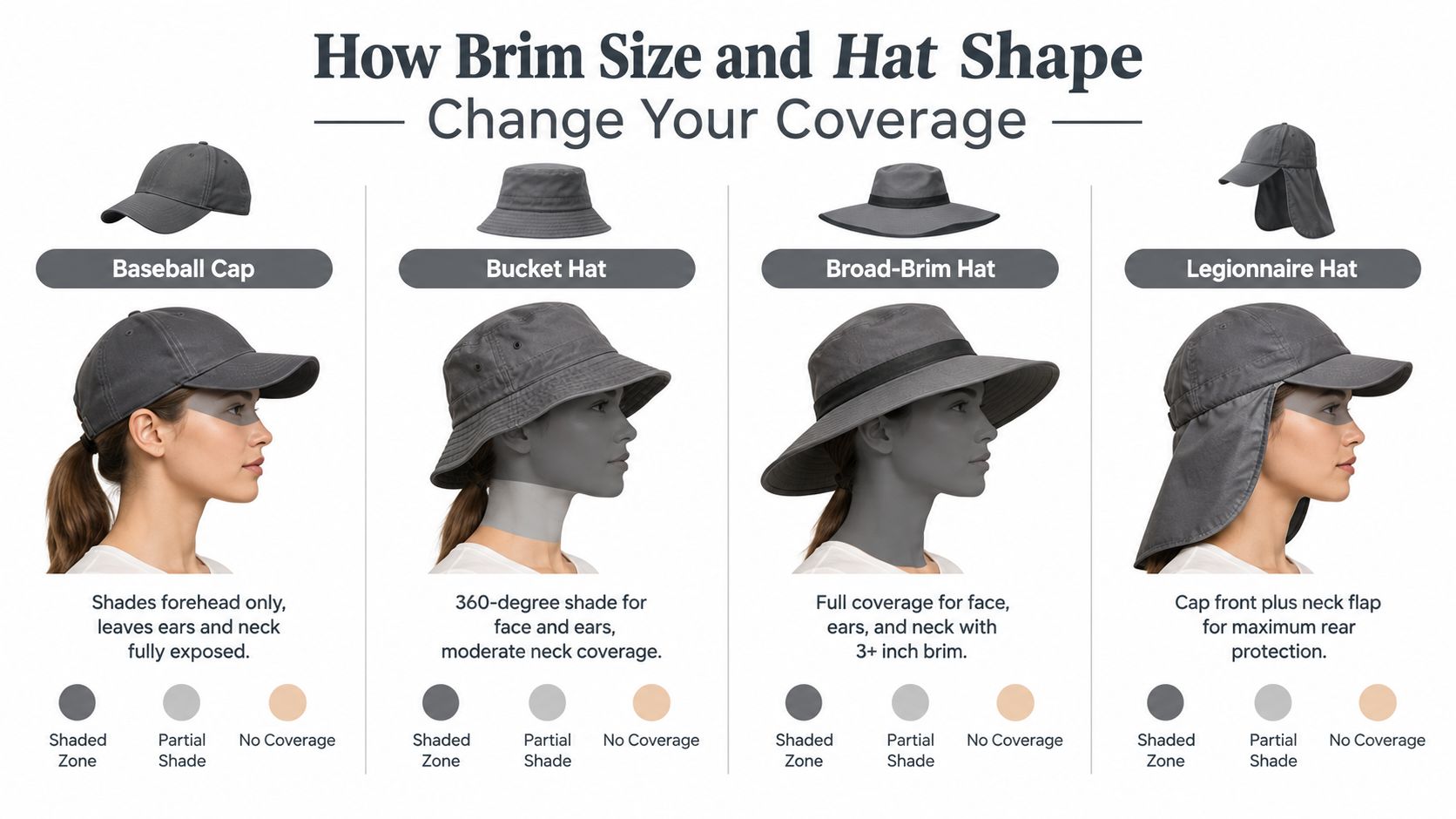
Official sun-protection guidance treats hat design as a major factor, not just fabric rating. Australian guidance identifies bucket, broad-brim, and legionnaire styles as sun-protective hat designs, and review literature notes that full-brim hats should have about 7 cm, or 2.75 inches, of brim coverage to meet protective standards in some markets (SunSmart hat guidance).
What each style actually does
Here's the honest version.
- Baseball cap: Best for glare control and forehead shade. Weak on ears, side face, and neck.
- Bucket hat: Better all-around face and ear coverage. Usually easier to wear casually than a full safari-style brim.
- Broad-brim hat: Strongest all-around shade if the brim stays shaped and doesn't flop into your line of sight.
- Legionnaire style: Great for neck coverage. Less versatile off the course or off the job site.
Why brim width matters more than front bill length
Men often overrate the front visor because it's what they see in the mirror. The side exposure is what catches up with you later.
A separate PubMed-cited line of evidence noted that peaked baseball caps protect the nose but are relatively ineffective for the rest of the face, while wider brims are needed for better cheek and side-face coverage (PubMed record). So if your main issue is red ears, sideburn area, or neck, a longer bill on a cap isn't solving the right problem.
Matching shape to your use
Personal style can still fit in.
If you want a bolder look with more brim presence, western and cowboy-inspired shapes can make sense for casual wear, outdoor events, or travel. If that's your lane, you can buy a winged cowboy hat and use it as a reminder that not every higher-coverage hat has to look purely technical.
For golf, brim geometry matters enough that it's worth understanding the details of golf hat brim design, especially if you're trying to balance sun shade with a clean sightline over the ball.
The best shape is the one that covers the zones you miss most without becoming so annoying that you stop wearing it by the third hole.
How to Choose the Right Sun Hat for Fit Comfort and Style
Coverage gets the hat into the conversation. Comfort decides whether it survives a full day.
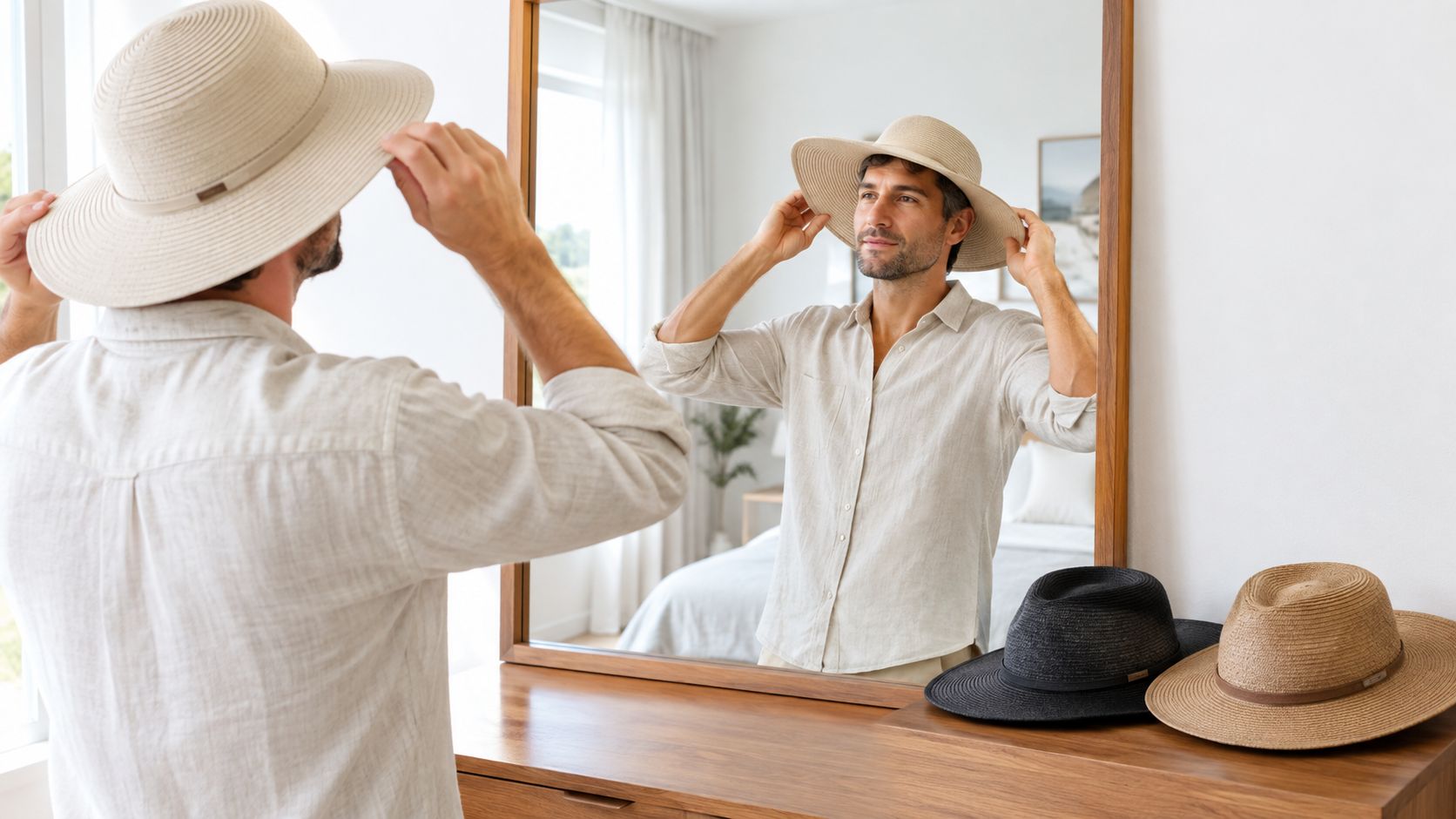
A hat can have the right brim and still lose because it pinches your forehead, fights your sunglasses, or lifts every time the wind picks up. That's why men end up back in caps. Caps are easy. Better sun hats need to be easy enough.
What to check in the mirror
Start with a simple try-on test.
- Front and side view: If the brim looks generous from the front but disappears at the sides, it's probably giving you less protection than you think.
- Sunglasses clearance: Put your sunglasses on before you decide. Some hats push the arms down or create pressure points above the ears.
- Head movement: Turn left, right, and look down like you're reading a putt or checking a phone. If the hat shifts badly, it won't stay put outdoors.
A useful middle ground for many guys is a structured bucket or a performance broad-brim that doesn't feel floppy. That's often where practical wearability lives. Brands across golf and outdoor categories offer this kind of compromise, and 2ndShotMVP is one option in that mix for golf headwear and lifestyle styles that keep the on-course look familiar.
The small design details that matter
The market review discussed earlier noted that hats intended for sun protection were evaluated not just for UPF-rated material but also for structural features such as limited ventilation eyelets. That matters because every opening is a trade-off.
Look for these details:
- Brim stiffness: Too soft and it collapses in wind. Too rigid and it can feel awkward off the course.
- Crown depth: A shallow crown tends to ride up and expose more than you planned.
- Vent placement: Breathability helps, but giant perforations can work against the whole point.
- Adjustability: Drawcords, rear tabs, or a secure fit matter if you play in gusty conditions.
Here's a quick visual guide before you buy.
A field test for actual wearability
Take the hat outside for five minutes. Not in your hallway. Outside.
Walk into sun. Turn into wind. Put your sunglasses on. If you immediately start fussing with the brim, the fit, or the crown, that annoyance multiplies over an afternoon. Hats for sun protection for men only work when they stay on your head without becoming your whole personality.
Tips for Wearing and Caring for Your Sun Hat Every Day
Most hat problems start after the purchase. A good hat gets tossed in the back seat, crushed in a travel bag, sweat-salted into stiffness, then blamed for not feeling great anymore.
Daily use is where habits matter.
Wear it for the conditions you're actually in
A broad-brim hat works differently walking a course than riding in a cart. In a cart, you'll get shifting sun from the side, reflected light, and more breeze. Walking usually keeps your body angle more consistent, but you'll sweat more and start adjusting for comfort if the fit isn't right.
A few habits make a big difference:
- Face the brim where the exposure is: Driving, spectating, or sitting sideways in a cart changes where the sun hits.
- Use sunscreen on the misses: Ears, jawline, lower cheeks, and neck still need backup.
- Keep sunglasses in the system: A hat without eye protection leaves glare and exposed skin around the eyes in play.
A hat is not a force field. It's a shade tool.
Keep the brim doing its job
Brim shape is performance. Once it gets crushed flat or bent into odd angles, coverage changes.
- Store it with intention: Don't bury it under shoes in a trunk or locker.
- Dry it before stuffing it away: Sweat-soaked hats get funky fast and often lose shape.
- Clean gently: If you wear golf hats often, this guide on how to clean golf hats is a useful reference for keeping structure and appearance from going sideways.
Build a hat rotation you'll actually use
One mistake I see all the time is trying to make one hat handle every job.
Better move:
- Course hat: More coverage, more technical, made for long exposure.
- Everyday hat: Easier to wear around town.
- Beater hat: Yard work, beach chair, dog walk, travel abuse.
That setup keeps you from babying one hat or abandoning a better-protection option because it feels too precious or too specialized for normal life.
Find Your Perfect Sun Hat and Enjoy Every Round More
The easiest way to choose is to stop shopping by category name and start shopping by exposure pattern.
If you mostly play golf, ask whether your problem is glare, ear burn, or neck burn. If you travel and walk a lot, think about packability and whether the hat still looks normal off the course. If you spend hours outside working, go harder on coverage and fit security than on style points.
A quick decision filter
Use this shortlist when you're comparing hats:
| Main use | Best starting point |
|---|---|
| Golf with lots of walking | Structured bucket or stable broad brim |
| Casual daily wear | Bucket or fuller-brim casual hat |
| Driving and commuting | Shape with better side-face shade |
| Yard work or long outdoor days | Broad brim or legionnaire style |
What works in the real world
Men usually don't need the most protective hat on paper. They need the most protective hat they'll wear repeatedly.
That's why the order matters:
- Coverage first
- UPF second
- Comfort and style third
Get those three lined up and your hat becomes gear, not a costume. You stop treating sun protection like a special-event chore and start treating it like grabbing tees, sunglasses, or a glove before the round.
Check the mirror from the side, not just the front. That's where bad hat decisions show up.
The sweet spot for most guys is a hat that shades more than a cap, doesn't flap around in wind, works with sunglasses, and still feels like something you'd wear voluntarily after the round. Find that lane and stick with it.
2ndShotMVP makes premium golf hats and lifestyle headwear designed for people who want to look right on the course and still wear the gear off it. If you want headwear that fits the golf-life balance this article talks about, take a look at 2ndShotMVP and find a style you'll keep on when the sun is high.


![300 Yd Bombers Club - Fun MVP - WhiteFun Hat [FlexFit]300 Yd Bombers Club - Fun MVP - White](http://store.2ndshotmvp.com/cdn/shop/files/closed-back-structured-cap-white-front-67005555ae157.jpg?v=1747428788&width=480)
![300 Yd Bombers Club - Fun MVP - WhiteFun Hat [FlexFit]300 Yd Bombers Club - Fun MVP - White](http://store.2ndshotmvp.com/cdn/shop/files/closed-back-structured-cap-white-back-67005555b0682.jpg?v=1747428789&width=480)
![72 - Fun MVPFun Hat [FlexFit]72 - Fun MVP](http://store.2ndshotmvp.com/cdn/shop/files/closed-back-structured-cap-multicam-black-front-666a5fa015432.png?v=1747448488&width=480)
![72 - Fun MVPFun Hat [FlexFit]72 - Fun MVP](http://store.2ndshotmvp.com/cdn/shop/files/closed-back-structured-cap-multicam-black-back-666a5fa017c12.png?v=1747448489&width=480)