

Saturday morning, the scorecard has already started telling stories before anyone reaches the clubhouse. Your partner makes a birdie on the par-3 seventh, struts back to the cart like he's found the secret to Augusta, then takes a triple on the par-5 twelfth and spends the next few holes studying the steering wheel. By the time you're walking toward the bar, the round is half celebration, half therapy.
That's the charm of birdies and bogeys. They aren't just entries beside a hole number. They're the bold plot twists, quiet recoveries, bad decisions, lucky bounces, and heroic putts that turn a round into something worth retelling. A birdie gives the story lift. A bogey gives it a little grit.
Walking Off the 18th Green With a Story to Tell
The scoring tent is where the round becomes a conversation. Someone is still arguing that the ball moved in the rough. Someone else is replaying a six-foot putt that looked in all the way. Your playing partner has one hand on the card and one hand already thinking about the first drink, trying to decide whether the birdie on seven deserves more attention than the triple on twelve.
It probably does, but not for the reason he thinks.
A birdie shows what the golfer can do when the drive finds the fairway, the approach lands in the right window, and the putter behaves. A bogey shows what happens when one of those pieces disappears. The scorecard holds both versions of the player at once, and the gap between them is where the useful lesson sits.
Clubhouse rule: The score you celebrate tells you what's possible. The score you regret tells you what needs a plan.
The words themselves carry a bit of golf's travelling history. “Birdie” is an American term whose commonly cited origin dates to 1903 at Atlantic City Country Club in New Jersey, where A.B. Smith reportedly called an exceptionally good shot “a bird of a shot.” “Bogey” appeared earlier in England, around 1890, when Hugh Rotherham of Coventry Golf Club established a target score known as the “ground score.” The history is outlined in this account of golf's fundamental vocabulary, and it helps explain why modern golfers on opposite sides of the Atlantic use the same language for a round's highs and lows.
The 19th hole extends that language. A birdie becomes a raised eyebrow and a second telling of the story. A bogey becomes an excuse to mention the wind, the lie, the pin, or the playing partner who started talking during the backswing. If the round involves clients, friends, or a group visiting the Hamptons, arranging a comfortable ride can keep the post-round conversation going without anyone worrying about the drive home. A service such as Hamptons Leisure Limo for golfers fits naturally into that part of the day.
That's why birdies and bogeys have outlasted plenty of scoreboard jargon. They make a round easy to understand, even when the golfer who played it is still trying to understand what happened.

What Birdies and Bogeys Actually Mean on the Scorecard
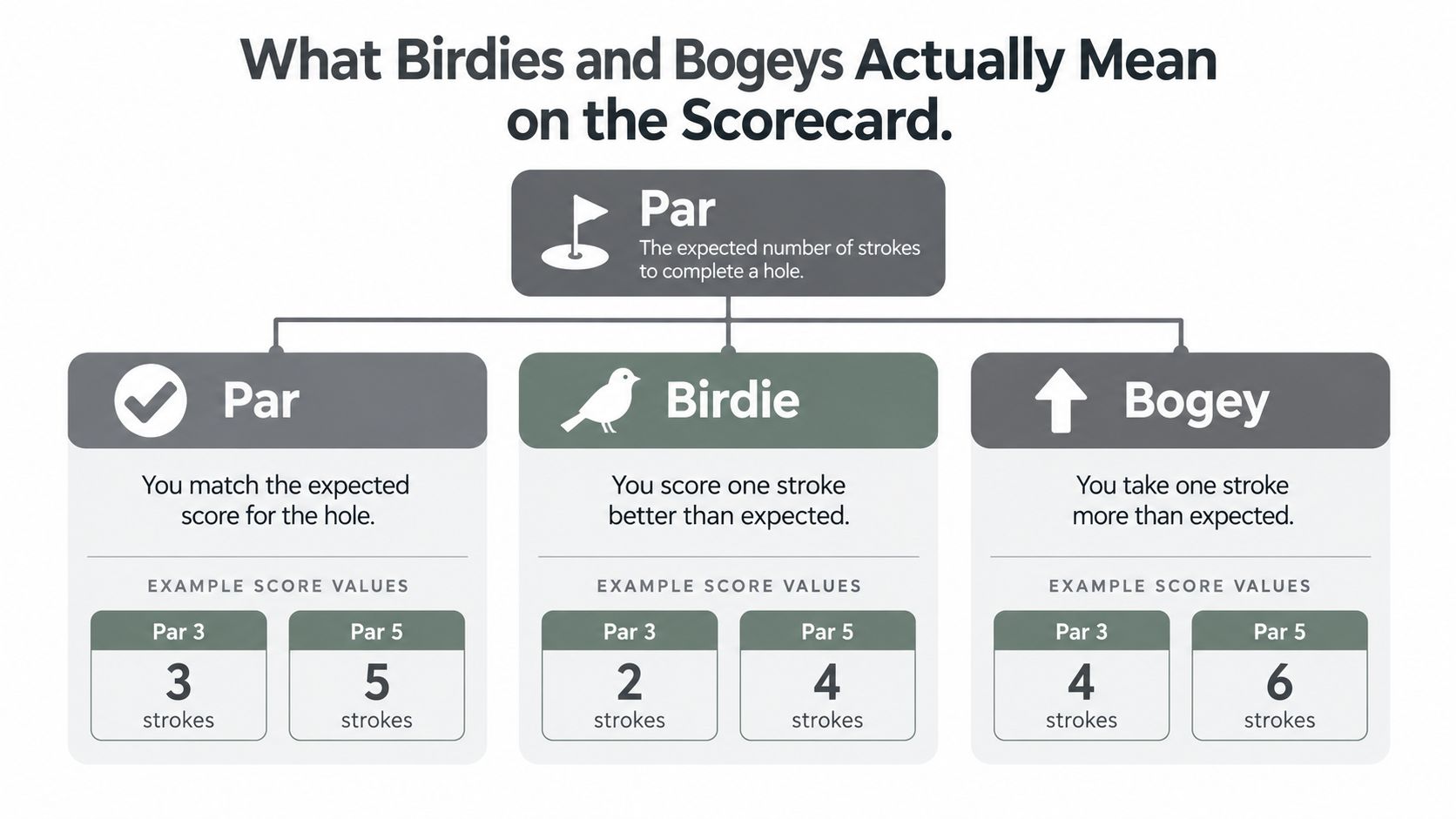
Think of par as the budget for a hole. On a par-4, the course gives you four strokes to spend. Finish in three and you've come in under budget. Finish in five and you've paid a small overdraft fee. Finish in six and the bank manager is probably walking over.
The scorecard ladder is simple:
Birdie: one stroke under par.
Par: the expected score for the hole.
Bogey: one stroke over par.
Eagle: two strokes under par.
Double bogey: two strokes over par.
On a par-3, a score of two is a birdie, three is par, four is a bogey, and five is a double bogey. On a par-5, a score of four is a birdie, five is par, six is a bogey, and seven is a double bogey. The arithmetic changes with the hole, but the relationship to par stays put.
The word par also arrived through a different route from the slang. The USGA officially recognized par in 1911, defining it as the score expected from “perfect play without flukes” under ordinary conditions, with two putting strokes allowed on each green. The R&A adopted a comparable standard in 1925. That timing matters because golfers were already using informal scoring language before governing bodies finished formalizing the benchmark underneath it.
One hole, read three ways
Suppose you're standing on a par-5 and hole the ball in four strokes. You've made a birdie. Take five and you've made par. Take six and you've made a bogey. The score doesn't need a dramatic explanation. Its meaning comes from the hole's par.
An eagle deserves its own place on the ladder. A three on a par-5 is an eagle, not two birdies, even though it's two strokes below par. That distinction becomes important when you compare a player's birdie totals with broader under-par scoring.
For a clean introduction to the marks and abbreviations you'll see on a card, Live Tourney's scoring guide offers a useful reference. You can also keep this guide to reading a golf scorecard handy before your next round.
Once those terms settle in, the card becomes less mysterious. A birdie is not just “good,” and a bogey is not automatically “bad.” Each one tells you how far your result moved from the hole's starting budget.
How Professionals Stack Birdies Against Bogeys
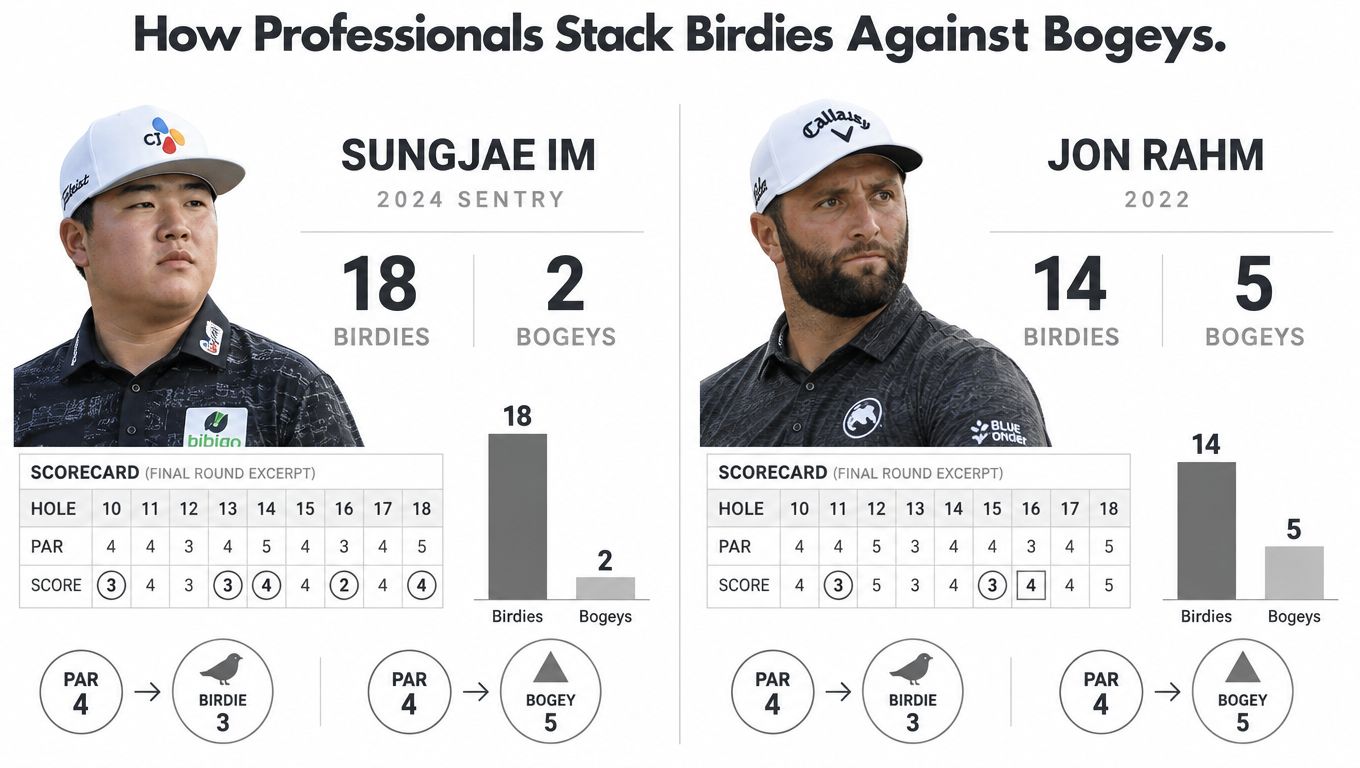
Sungjae Im's card at the 2024 Sentry reads like a player walking a narrow bridge while carrying a bucket of birdies. He made 34 birdies, the PGA Tour record for most birdies in a 72-hole tournament. He also recorded 30 pars, 7 bogeys, and 1 double bogey, a combination that makes the point better than a spotless card would.
The round wasn't built by eliminating every mistake. It was built by creating enough scoring opportunities that the mistakes couldn't take over the story. A bogey costs a stroke, but a steady supply of birdies keeps replenishing the account.
The previous record was 32 birdies, achieved by Jon Rahm at the 2022 Sentry and earlier by Mark Calcavecchia at the 2001 Phoenix Open and Paul Gow at the 2001 BC Open, as reported in the record review of 72-hole PGA Tour birdie totals.
Why the categories stay separate
Tour statistics distinguish between birdie production and bogey avoidance because they describe different skills. One player may attack well and create plenty of birdies. Another may build a score by keeping the ball in play and refusing to turn small trouble into a large number.
An eagle complicates the visual story. It counts as one eagle, not two birdies, even though it finishes two strokes under par. That's why analysts need separate categories instead of treating every under-par stroke as interchangeable.
For a recreational golfer, Im's card offers a useful correction to perfectionism. Elite scoring doesn't require a card without blemishes. It requires enough good holes, enough calm after mistakes, and enough trust in the next opportunity to keep one poor swing from becoming a whole afternoon.
A professional sees a bogey and looks for the next playable target. The amateur often sees a bogey and tries to win the stroke back immediately, usually by choosing the most dangerous club and the smallest landing area. That difference in response is where tournament golf starts to separate from Saturday golf.
The Momentum Math Behind Birdies and Bogey Chains
Golfers talk about momentum as if the previous hole can ride in the cart beside them. The feeling is familiar. A birdie makes the next tee look generous. A bogey makes the same hole look narrower, faster, and more hostile.
A peer-reviewed analysis of 107,405 PGA Tour holes found birdie-or-better on 18.84% of holes and bogey-or-worse on 18.28%. The study found a statistically significant cold-hand effect after bogeys, but no reliable evidence of a persistent hot hand after good results. The findings are available in the peer-reviewed analysis of consecutive scoring outcomes.
That doesn't mean a bogey curses the next hole. It means the player's response matters. After a dropped shot, the smart move is to reset decisions, choose a high-percentage target, and avoid trying to repair the card with one heroic swing.
The tee shot sets the size of the next decision
Shot Scope data adds a practical layer. For a 5-handicap golfer, average driving distance was 270 yards when making birdie or better, 258 yards when making par or better, and 247 yards when making bogey or worse, according to Shot Scope's performance data booklet.
The figures don't prove that distance alone creates birdies. Strike quality, lie, club selection, and approach proximity all influence the outcome. They do show the value of playable distance. A centered drive that travels farther can leave a shorter approach, a better angle, and fewer recovery decisions.
| Handicap | Birdie or Better | Par or Better | Bogey or Worse |
|---|---|---|---|
| 5 | 270 yards | 258 yards | 247 yards |
| 15 | 257 yards | 244 yards | 231 yards |
| 25 | 212 yards | 193 yards | 184 yards |
A useful reset after a dropped shot
The table isn't a command to swing harder. It's a reminder to improve contact and select a tee-shot strategy that keeps the next shot playable.
After a bogey, take a short reset before you choose a club:
- Name the result without drama. “Bogey” is information, not a personality test.
- Pick the safest useful target. Give yourself room to make a normal swing.
- Remove the previous hole from the decision. The next shot has its own lie, wind, and landing area.
- Keep your pace and body language steady. Your group shouldn't have to wait while you negotiate with the card.
The goal isn't to force a birdie after every par. It's to stop one poor hole from dictating the next one.
When Chasing Birdies Backfires for Mid-Handicappers
A 15-handicapper reaches the par-3 tee with the pin tucked beside a bunker. The wind is sliding across the green, yet the golfer selects the club that reaches the flag only with a perfect strike. One pulled shot finds the sand, the next chips long, and a possible par turns into a number that follows the player to the next tee.
The better question is simple: Where does a miss leave you?
A typical 15-handicapper makes bogey or worse on roughly 50% to 60% of par-3s and makes bogey 40% to 45% of the time on par-5s, according to this comparison of golf statistics by player level. PGA Tour players make bogey or worse on fewer than 8% of par-3s and birdie or better on nearly half of par-5s. Those golfers play in a different scoring environment. Borrowing their aggression without their strike quality and recovery skill can create the opposite result.
For a mid-handicapper, avoiding doubles often improves the card faster than hunting every birdie. The conservative target may leave a manageable putt for par and a simple bogey when the hole refuses to cooperate.
Rank the decision by hole type
Par-3: Make the middle of the green a real target, especially when the pin sits near a bunker, slope, or boundary. A bogey from a difficult lie can be a useful escape if the alternative is a short-sided recovery and a larger score.
Par-4: Begin with the tee shot. Choose the fairway side that leaves a broad approach area, even if it adds a little distance to the flag. Attack when the approach is comfortable, not just because the hole's par invites it.
Par-5: Let the second shot earn the right to be aggressive. A clean lie and an open route can justify chasing a birdie look. From poor turf or toward a guarded green, lay up to a favorite wedge distance and keep the likely damage contained.
A good bogey is the score you accept after choosing a miss that keeps the hole alive.
Review the last card and mark where each double bogey began. It is often the shot before the bad putt, when ego chose a target with no margin. If the bogey chain has started, our guide to bogeys in golf offers a useful review of how they develop and how to stop them. That same restraint carries into the 19th hole, where a scorecard full of recovery stories is easier to explain than one built on forced heroics.
A Pre-Shot Routine That Creates More Birdie Looks
The group reaches a short par-4, and one player aims at the flag before checking the lie, wind, or miss. Another picks a fairway side, chooses a green section, and steps in with one picture. The second player may not make birdie, but the decision creates a better chance without turning par into a rescue job.
Begin at the tee markers. Choose the set that gives you a realistic second shot and a comfortable pace, rather than treating the longest option as a test of courage. Read the hole through birdie access and bogey exposure. Is the fairway wide enough for driver? Does the pin invite a safe miss? Will a blocked approach leave a recovery with little margin?
Four decisions before the swing
- Choose a playable line. Favor the side that keeps the next shot open, even if it is not the shortest route to the flag.
- Select a landing target. Pick a green section large enough to accept a slight miss. Keep the pin in view without making it the only acceptable result.
- Commit to one club and one shape. A clear decision creates a better routine than changing plans over the ball.
- Reset after trouble. Breathe, read the lie, and choose the shot that returns you to a normal sequence.
The routine pays off in numbers you can control week to week. Track fairways hit and three-putts for a month. If fairways rise while three-putts stay flat, your approaches begin from better angles, and birdie looks follow without requiring a swing overhaul.
After a bogey, pause before the next tee shot. Do not rehearse the error or rush to prove the round is still intact. Stand tall, keep your tempo, and make the next target ordinary.
A missed fairway does not have to dictate the hole. If the ball sits cleanly, choose the largest useful target. If the lie is poor, accept a recovery that leaves the next shot playable. Handicap-aware golf gives each hole a different job, and the routine keeps one mistake from assigning the rest of the card.
The same habits help the group. A golfer who decides early, walks with purpose, and keeps the rhythm after a mistake is easier to play with. Confidence can look simple: being ready when it is your turn.
Birdies, Bogeys, and the Modern 19th Hole
The modern golf round doesn't always finish after a full 18 holes. In the United States, golfers posted a record 82 million scores in 2025, while 9-hole score submissions reached nearly 15 million, up 5% from 2024 and more than 46% from 2020, according to the USGA's report on golf participation and posted scores. More than 75% of golfers with a Handicap Index played and posted purely for fun, according to the same source.
That changes the emotional weight of a bogey. In a nine-hole round before work, an executive outing, a social scramble, or a quick loop at an executive course, the score is part of the experience rather than its sole verdict. The bogey can still sting, but it can also become the best story at the table.
The 19th hole is where players decide what the card means. The birdie might earn a toast. The bogey might explain the weather. The triple might become a story that improves every time it's told.
That's where golf lifestyle belongs. A hat, a drink, a handshake, and a good story carry the round from the final green back to the clubhouse. The number matters, but so does how you carry it.
2ndShotMVP offers golf hats, beanies, and lifestyle apparel for men and women, including Birdie and Bogey designs made for the course and the clubhouse. Visit 2ndShotMVP to find a piece that fits your next round, your next birdie story, and the bogeys you'll laugh about later.


![300 Yd Bombers Club - Fun MVP - WhiteFun Hat [FlexFit]300 Yd Bombers Club - Fun MVP - White](http://store.2ndshotmvp.com/cdn/shop/files/closed-back-structured-cap-white-front-67005555ae157.jpg?v=1747428788&width=480)
![300 Yd Bombers Club - Fun MVP - WhiteFun Hat [FlexFit]300 Yd Bombers Club - Fun MVP - White](http://store.2ndshotmvp.com/cdn/shop/files/closed-back-structured-cap-white-back-67005555b0682.jpg?v=1747428789&width=480)
![72 - Fun MVPFun Hat [FlexFit]72 - Fun MVP](http://store.2ndshotmvp.com/cdn/shop/files/closed-back-structured-cap-multicam-black-front-666a5fa015432.png?v=1747448488&width=480)
![72 - Fun MVPFun Hat [FlexFit]72 - Fun MVP](http://store.2ndshotmvp.com/cdn/shop/files/closed-back-structured-cap-multicam-black-back-666a5fa017c12.png?v=1747448489&width=480)